

Newtown scientist and artist Mary-Jane Walker moved to Geelong 11 years ago to save a heritage-listed 1850s home.
Now she wants to do the same for Geelong’s 84 endangered bird species. She tells Luke Voogt how.
“Vegan taxidermy” might seem like a contradiction, but Dr Mary-Jane Walker’s version is less macabre than it sounds.
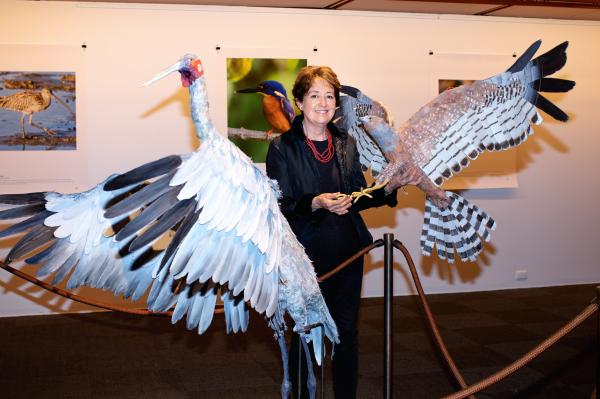
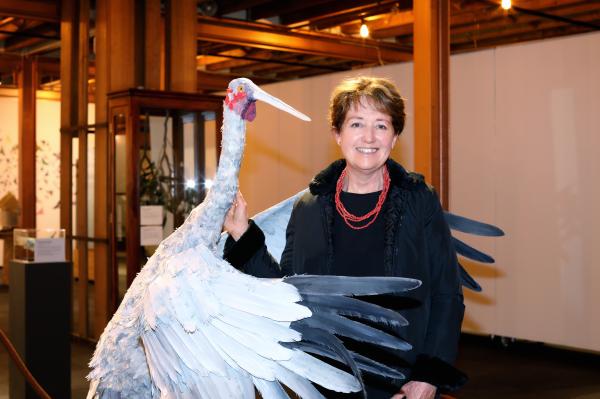
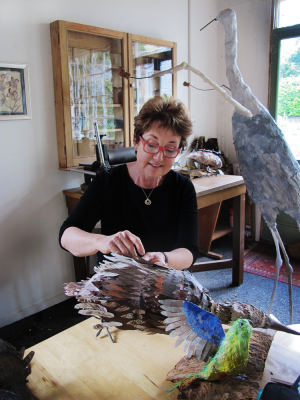
She crafts life-sized, life-like birds, carefully hand-cutting every feather from old newspapers, magazines and art paper.
“I’m sitting in my studio at the moment making the glossy ibis,” she told the Independent this week.
Mary-Jane spends several weeks per bird painstakingly matching magazine and newspaper photographs to the colours of their feathers.
“I might use ten [copies of the same photograph] for a single bird,” she said.
“For example, the feathers on the spotted harrier are actually an advertisement for the Northern Territory.
“When you look closely at the birds you can see some of the images in the feathers.”
So far she has crafted more than a dozen of Geelong’s 84 endangered bird species.
“Which is a huge number – the majority of people probably don’t know there are that many,” she said.
“I had this crazy idea that I would make them and bring them into people’s lives, so they can make that emotional connection.
“They can experience what it’s like to walk up to a brolga, a shy albatross, a barking owl or a spotted harrier.”
Mary-Jane is both a scientist and an artist, and describes her work as the “intersection of these two spheres”.
“My science informs all my art, particularly in relation to the natural world,” she said.
“For me it’s not too different, working in my studio or in a laboratory – it’s all about experimenting with ideas.”
She says that art can help communicate scientific concepts, like the importance of protecting the environment.
“When people see a work of art they react in a different way – it’s a more emotional connection,” she said.
Mary-Jane’s love of art grew while studying at Ruth Tuck Art School in South Australia.
But she leaned more towards science in her career, completing a doctorate in molecular genetics at the University of Edinburgh studying snake DNA.
“I found as an Australian I could relate to Scotland more than [built-up areas of] England,” she said.
“A lot of Scotland is still relatively wild – there’s still that sense of freedom.”
She moved to Geelong 11 years ago, gradually acquiring historic 1850s home Chesterfield in Newtown.
The property was once home to prolific Geelong architect Joseph Shaw and Gordon Technical School forerunner William Pye.
“I came across a picture of the house – part of the property was being sold,” she said.
“When we walked around the property … my husband and I felt someone should save it for Geelong.”
They lovingly restored the property and nursed three roughly 160-year-old Norfolk Island Pines back to health with worm culture.
“It contains a lot of fungal spores and – this is my scientist talking – trees need a fungal network,” she explained.
“It improves the heath of the soil and helps trees become healthier, stronger and better.
“We’ve put it back almost to the way it was in the 1850s. We have our own bees and hens too.”
Several years ago, the mother-of-four (now adults) graduated art at RMIT.
Her work has since toured Europe in a climate change exhibition and private collectors in England, Canada and Australia have bought her pieces.
Now, driven by her passion to “preserve things worth preserving”, she is using her artistry to highlight the plight of 84 bird species.
“Protecting the species here in Geelong matters and I think people realise that – you just have to make them aware [that they are endangered].”
With the help of fellow artists Jen Tostevin and Rob Cutler, she now has 15 species on show at Geelong’s National Wool Museum, along with bird calls recorded by Deakin University.
“Some of the very large birds, like the brolga and the albatross, have a steel frame in them – some of these birds are huge,” she said.
Her exhibition, Now You See Us, is set to reopen along with the rest of the museum tomorrow, after briefly opening earlier this year before COVID-19 hit.
“I’m delighted for it to be reopening – the birds have been sitting there in the dark,” she said.
Mary-Jane described the pandemic as “a productive time” for her, in which she created several new models.
While the pandemic took a terrible toll, it had reaffirmed the importance of science and the fact that human life is woven into “the biological fabric of this planet”, she said.
“This virus started with a single bat and it has spread around the world. It’s showed us how we’re all connected in this fragile, finite system hanging in the blackness of space.”
She believes the National Wool Museum’s focus on sustainability will help inspire creative local solutions for global problems.
”We could carve one of the great green cities of the world here in Geelong.”