

Ever been eyeballed by a car?
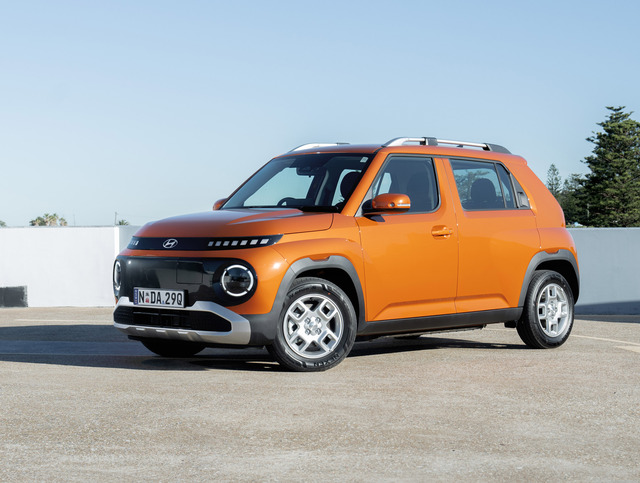
Recently, while picking up a Hyundai test vehicle, I had the strange feeling the eyes (aka round headlamps with a ring of LED daytime running lights) of the Inster all-electric light SUV were following me.
On top of this, positioned below was a wide grille with the superior look of a knowing smile? Creepy?
The maker sees things differently, explaining the ethos of the Inster by saying the set-up makes for ‘a futuristic yet playful first impression.’
All flippancy aside, Hyundai’s smallest and most affordable SUV has every right to appear superior, having been named the 2025 World Electric Vehicle by a jury of 96 international motoring journalists from 30 countries. Winners were announced at the New York International Automobile Show.
Available in three variants – Standard Range and Extended Range – focused, as the designation suggests, on the distances travelled on a fully charged battery, plus the Cross Extended Range, which includes a roof basket option designed for the adventurer.
These range from a claimed 327km for the entry-level Standard to 360km for the Extended and Cross models.
Prices start at $39,000, on-road costs, for the Inster Standard Range. The Extended Range is $42,500, while the Inster Cross, with roof basket option, or sunroof tops off the list at $45,000.
Warranty is five years unlimited kilometres and eight years,160,000km on the high-voltage battery.
STYLING
Kitted out in Urban Khaki, the test vehicle reminded me of the colour, or lack of it of a US ex-army combat jacket I bought from the British Army and Navy Stores, a post-war military op shop popular with ‘Ban the Bomb’ types of the day.
However, the under-stated battle-dress shade of the paintwork provided the perfect backdrop for the futuristic black circuit board-style bumper and the aforementioned round LED eye-like daytime running lights.
Robust wheel arches house stylish 15-inch (on Standard Range) alloy wheels imparting a sporty SUV character.
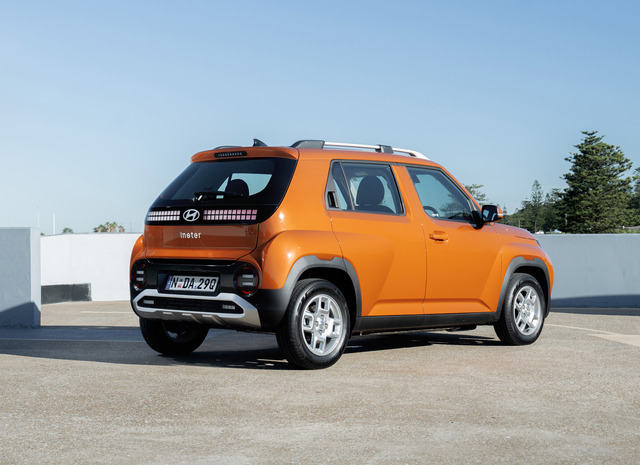
Out back, the Inster continues its futuristic foray with Parametric Pixel LED combination lights, rectangular LED turn signals and circular reflectors, not forgetting a silver skid plate. Back on Earth, the use of eco-friendly high-gloss paint, recycled from waste tyres, backs up Inster’s environmental credentials.
INTERIOR
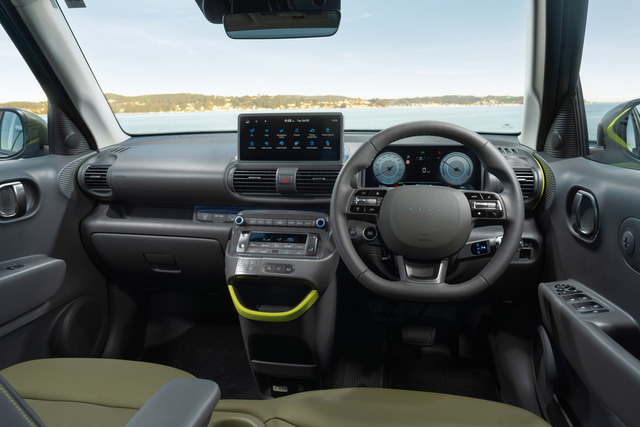
Strictly a four-seater, a cleverly crafted cabin serves up a comfortable bench-style front row with compact centre console and versatile sliding and reclining 50:50 split folding rear seats with ample leg room.
A cloth interior made from recycled PET is offered In the Standard Range, with cargo of up to 280 litres, with seat backs up and 351 litres with them folded.
INFOTAINMENT
Up-to-the-minute tech is at the heart of a futuristic driving experience, while vehicle-to-load (V2L) capability of Hyundai Bluelink connected services, wireless phone charging and adjustable regenerative braking, is complimentary for the first five years.
This Bluelink connection is transferrable within that time and includes automatic collision notification with SOS function, live traffic updates, remote control of climate and vehicle functions, plus voice recognition for points of interest.
Front and centre of the cabin is a 10.25-inch digital cluster and 10.25-inch infotainment touchscreen incorporating satellite navigation. Minimalistic interactive pixel lights on the steering wheel add to a feel of the future and pass on info such as battery charging status and driving mode.
With over-the-air technology, vehicle navigation software can be updated remotely by following on-screen prompts.
ENGINES/TRANSMISSIONS
Inster Standard Range uses a single electric motor sending 71.1kW of power to the front wheels, the Extended range ups that to 84.5kW. A Standard Range 42kWh battery claims up to 327km of range on 15-inch wheels, while the Extended model 49kWh battery extends that to 360km on 17s.
Plugged into a DC charging station, delivering 120kW or more, it’s claimed Inster will fast charge from 10 to 80 per cent in as little as half an hour. In practice, the test vehicle on a 27.10kWh charge went from 30 to 90 per cent in less than 40 minutes.
SAFETY
A comprehensive suite of Advance Driver Assistance Systems is standard on Inster models. Actively helping are highway driving assist that uses a windscreen-mounted camera, radar and navigation data, to assist the driver keep a set speed and distance from the vehicle ahead, while keeping Inster centred in the lane.
Also, at the behest of this camera, intelligent speed limit assist combines road sign recognition with navigation data to tell the driver the current speed limit.
An in-cabin camera, by checking the face, makes the driver aware of drowsiness or inattention with an alert, or start preventive action to avoid an accident.
Occupants are protected by seven airbags, including front, front side, side curtain, and a front-centre airbag, plus an alert to prevent unintentional locking in, or leaving behind, children or pets.
DRIVING
The Inster is at home in the lunge and parry of city centre and suburban driving. Quietly going about business, the Standard variant, on 15-inch wheels, claims a get-go of 11.7 sec from stand-still to 100km/h on to a top speed of 140km/h.
Performance can be tailored to the driver’s liking using regenerative braking, via steering wheel-mounted paddle shifts, the battery performance can be boosted in traffic or on the open road.
Tranquility is the name of the game in the cabin thanks to double door seals, thick front door glass, free airflow around the headlamp strip and the addition of a front underbody cover, which also reduces drag.
The motor is fixed to the body by fluid bushes, improving ride quality and reduced vibration compared with conventional rubber fixings. High performance dampers deliver optimal body control shock absorption.
Comfort at higher speeds benefits from a reinforced steering system structure, optimised steering damper and steering wheel designed to cut vibration transfer.
SUMMARY
Inster the World Electric Car of 2025, eh? Styling (tick), performance (tick), comfort (tick), convenience (half a tick). With a Standard maximum range of 327km (a local derby for a bush footy team) and sparse public battery charging infrastructure, EVs still have a long way to go. As for replacing fossil fuels altogether, according to my cardiologist, a frequent outback driver: “We’ll all be dead by then.” He should know.
RATINGS
Looks – 8
Performance – 7
Safety – N/A
Thirst – 7
Practicality – 7
Comfort – 6
Tech – 8
Value – 7