
Smartwatches and other wearable devices are ubiquitous in the world of sport and fitness.
But how well do they really measure when other variables are at play?
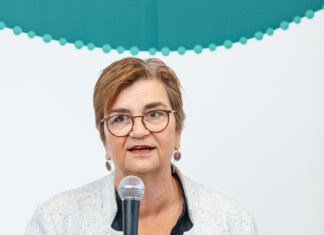
That’s exactly what Deakin Centre for Sport Research’s Dr Claire Kenneally-Dabrowski intends to find out.
“Around three-quarters of runners say they use wearable technology or running related apps when exercising,” she said.
“These are often handheld or worn on the wrist and monitor physiological training metrics, such as distance and speed, to help them track their training progress and manage injury risk.
“But the accuracy of these devices to measure biomechanical load – or physical load on the body – is still unknown.
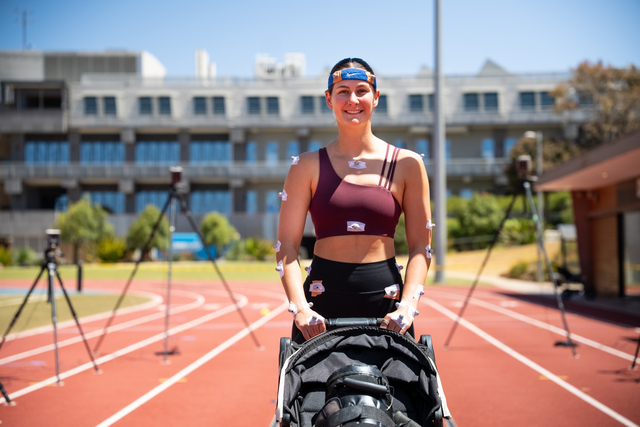
“For this study, we want to validate data from Garmin smartwatches to measure biomechanical load when running, with the novelty being that participants will also run with a pram.”
To put the smartwatches to the test, Dr Kenneally-Dabrowski’s team is testing runners over a 60m course with a 10kg weight in the pram to simulate a one-year-old child.
“We’ll compare the data from the smartwatches with 3D motion analysis to understand how accurate it is,” Dr Kenneally-Dabrowski said
“The 3D motion analysis uses infra-red cameras to track reflective markers on the participant allowing researchers to record the precise position, speed, and orientation of a runner and their limbs in three-dimensional space.
“This is a gold-standard measurement process that can be used to inform training plans and any adjustments needed during training.
“It is especially useful for women who are getting back into exercise after having a baby as they may be experiencing increased fatigue and altered movement patterns when running. When coupled with the additional load and unique running technique of pushing a pram, accurately monitoring their running load can help them progress gradually and avoid injury.”
Dr Kenneally-Dabrowski said another element of the research would explore how runners preparing for endurance events of more than 10km could use wearable technology to monitor training load and thus inform their training.
“This will be of interest to endurance runners preparing for the 2026 Geelong Marathon who are curious about the information wearable devices can provide to inform their training,” she said.