

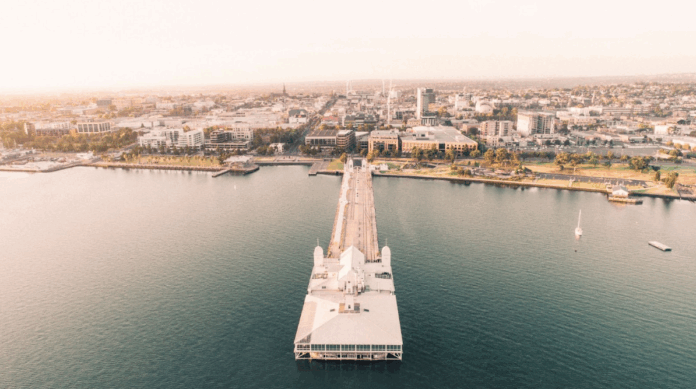
Geelong has always been a city of quiet confidence. The kind that you only recognise after spending a few years down here, feeling the sea air slice through a morning commute or watching lights flicker on along the waterfront while factories across the road wake up behind you.
A city of work and progress, shaped by those who’ve left and returned, those who stayed and those who chose Geelong as a new beginning. Those in the know usually take the same pride in telling you, “We’re not Melbourne and that’s exactly the point.”
Over the past decade, something has quietly changed. You can feel it in the emerging industries in suburban parks, in the students on their way between Deakin buildings from every corner of the world and in the meetings in council rooms and community forums. Geelong is no longer the satellite city it has been, it is instead actively participating in the global conversation on trade, security, cultural and innovation exchange.
So let’s explore how and why that change is taking place.
Geelong’s Transformation in a Global Context
Geelong’s transformation is also being driven by global forces now landing on the city’s doorstep. Recent research on trends in fields as diverse as urban policy to master of international relations programs are arriving at the same conclusion: migration flows, foreign investment and cross-border education exchanges are the forces rapidly reshaping regional cities earlier than expected.
This is playing out locally in Geelong’s shifting demographic profile. New migrant communities finding a home here, interstate movers coming for affordability and Melburnians leaving the city for more space and a coastal lifestyle are just some of the factors driving council planning into a new and future-focused mindset.
Deakin’s increasing international attraction has also brought Geelong into closer alignment with global education and research networks through the students and partnerships, strengthening the city’s ties to countries and regions around the world. Tourism maintains that connection year-round, with Geelong as the entry point to the Great Ocean Road, the Bellarine and some of Australia’s most recognisable surf beaches.
Throw in the increasing level of foreign investment in defence, manufacturing and clean-energy projects, and the picture is clear: Geelong’s trajectory is now as much about global attention and global flow as local ambition.
From Satellite City to Strategic Regional Centre
Understanding Geelong’s move from satellite city to strategic regional centre is simple when you understand Geelong’s history and how it developed in parallel to but slightly detached from Melbourne. For many years, Geelong’s status as the Motor City, a manufacturing hub, a “country city” and an accessible alternative to Melbourne dictated its identity. Generations of residents chose the region for the lifestyle and “went to work up the road” for the opportunities they wanted or needed. That was the city’s operating model for decades.
But a combination of factors over the past 20–30 years changed that script. Major infrastructure developments, such as the Ring Road and the expansion of Avalon Airport and the port, disconnected Geelong from Melbourne, and investment in self-sustaining industries allowed Geelong to stand independently.
New industries such as health, education, tourism, advanced manufacturing and defence have also diversified and matured, making it less vulnerable to downturns. The city has also attracted population growth, which also came with new demographics, new expectations and a new, more diversified workforce to power the local economy.
Geelong is no longer a “fallback” for Melbourne or a city that receives the overflow from Melbourne. It’s a fully-fledged regional centre with its own identity, its own industries and its own internal momentum.
Economic Engines Driving Geelong’s Next Phase
Innovative companies are fuelling Geelong’s economic growth in industries as diverse as advanced manufacturing and defence, clean energy, health and technology, and education and training. The jobs they are creating will not only be local but also in industries capable of feeding the national and international supply chain. Geelong’s large distribution centres and transport infrastructure and port access means it will be shipping goods and services to other cities around Australia and overseas.
Take Cotton On, for example. The company may have been a Geelong start-up, but its Geelong headquarters and distribution operations now service stores around the world; in fact, quite literally shipping products from Geelong to the world. It is another great example of how the growth drivers of the city’s economy have the capacity to service and impact markets far beyond the region’s borders.
Infrastructure and Urban Renewal: Building a City for the Future
Geelong’s infrastructure and urban renewal initiatives are reinvigorating the city from the ground up. Transport upgrades such as the Ring Road extension and Geelong-Melbourne rail line enhancements are alleviating traffic congestion, enabling quicker commutes and freight movement. Additionally, expanded bus services and new cycling routes are enhancing local connectivity. Housing supply is ramping up in emerging suburbs like Armstrong Creek and Fyansford, with the construction of contemporary apartments and family homes to accommodate the influx of new residents.
The Waterfront precincts are emerging as a hallmark of Geelong’s urban renewal efforts, with the revitalisation of Eastern Beach and Steampacket Gardens creating inviting public spaces for recreation, events, and tourism. Mixed-use precincts are also playing a significant role in the urban renewal agenda, with the Geelong City Centre and Waurn Ponds developments fostering the growth of cafes, co-working spaces, and cultural hubs alongside residential expansion.
These projects are increasingly incorporating sustainability measures, with initiatives such as stormwater management systems, energy-efficient building designs, and the integration of green spaces into urban precincts contributing to a more liveable city as it grows. These tangible investments in urban renewal and infrastructure are helping Geelong to become a more connected and modern city, where economic opportunity is balanced with a high quality of life.
Talent, Education, and Workforce Development
Education is more than a service in Geelong; it’s a talent incubator. Universities and training facilities do not simply teach — they’re integral to the city’s workforce development and future industry sectors. Deakin University is a national powerhouse in health, engineering and cybersecurity, with the Waurn Ponds campus attracting students, researchers and visiting scholars from around the world. The Gordon TAFE also plays a crucial role in practical skills training, with programs in trades, aged care, digital and creative technology, as well as advanced manufacturing.
Locals are also finding opportunities to upskill and gain in-demand skills through training and courses aligned with industry needs. The Geelong Manufacturing Council’s apprenticeship initiatives and tailored training in areas such as renewable energy, smart tech, and defence manufacturing are examples of where Geelong is leading the sectors in which it operates. It’s also able to develop talent that is uniquely local, with a deep understanding of the global marketplace.
Innovation, Research, and Industry Collaboration
Regional cities are no longer on the back foot when it comes to being centres of research and development. In fact, Geelong is a leader in innovation and applied research. The Geelong Innovation and Advanced Manufacturing Precinct is a hub for startups, scale-ups, and established businesses. Here they partner with companies worldwide, working on research and commercialisation projects in many areas of national industry including energy, health and advanced manufacturing.
The NDIS Innovation Centre, Thales collaborative R&D and a smart mobility partnership with Ford are three examples of how Geelong is creating real outcomes from this global-local relationship, whether that’s in the areas of clean energy, defence or advanced automotive technology. Collaboration and partnerships create opportunities for Geelong students, entrepreneurs and engineers to put theory into practice on real-world problems, developing prototypes and R&D projects that have an impact nationally and internationally.
Community, Culture, and Lifestyle Advantages
One of Geelong’s major advantages is its people. The city is in a sweet spot for families, young professionals and retirees: it’s a mix of accessibility to other beautiful areas, culture, and community, combined with a relatively lower cost of living, and an increasingly walkable city centre and waterfront precinct.
The Great Ocean Road is only an hour north, with the Bellarine Peninsula and beaches along the Surf Coast just a short drive south for surfing and sunrises on weekends and school holidays. Families, young professionals and retirees alike can afford to buy or rent in Geelong, and are choosing to put down roots in a way that would be difficult in the capitals.
Culture and community are at the heart of what Geelong offers too. The Geelong Gallery and Geelong Performing Arts Centre are cultural centres where locals and visitors alike can enjoy world-class collections and performances. There’s also a growing array of festivals that celebrate diversity in the city, including Pako Festa. At the same time, new developments along the waterfront and the city centre provide places to live, work, socialise and host community events and gatherings.
Why Geelong Is Poised to Become a Global Hub
For the first time in a long time, this city is building a foundation for sustainable, long-term prosperity. It is diversifying its economy through advanced manufacturing, clean energy, defence, health and education. Its universities and training facilities are creating a skilled and agile workforce and its innovation precincts and research partnerships are ensuring the next big idea and the next new technology is discovered here and then delivered to the world.
Add to that smart infrastructure, urban renewal and work, culture, lifestyle, nature and surf coast all rolled into one attractive package, and Geelong has everything it needs to draw in talent, investment and opportunity.
This is the city Geelong is today. The city we can be proud of and the city ready for its next chapter. Not just as a regional city, but as a city where the world is now starting to pay attention and where that attention will only grow.
Geelong is ready to go. The foundation is in place. The talent is here. The vision is there. The city that connects, that is agile and resilient, is a city that will put its mark on the world stage for decades to come.