


All eyes are on Milano at the moment. The Milan-Cortina 2026 Winter Olympics are currently underway, and the competitions are delivering dramatic storylines and historic performances. Venues that faced construction delays and safety concerns are now hosting world-class competition, and the Games have already tested how Italy handles the pressure of the global spotlight.
That is exactly why the attention on Italy has reignited debate in Australia, where Victoria’s planned 2026 Commonwealth Games collapsed before a single starting gun was fired. What was meant to showcase regional centres like Geelong instead became a case study in planning failure, and the lessons matter now more than ever as Brisbane prepares for the 2032 Olympics.
How Partnerships Delivered Under Pressure For Italy
Despite its own controversies involving the mafioso and corruption, Milan-Cortina demonstrates how strategic partnerships can salvage mega-events. The organising committee secured 52 official partnerships across multiple tiers, including eight premium partners like ENEL, Leonardo, and Intesa Sanpaolo. The sponsorship programme targeted €575 million in revenue, with €400 million secured by February 2025.
Crucially, these weren’t mere sponsorships but operational collaborations. Leonardo provided mission-critical communications infrastructure. Deloitte delivered professional services and governance frameworks. This collaborative delivery model meant the Italian government wasn’t shouldering every technical and financial risk alone.
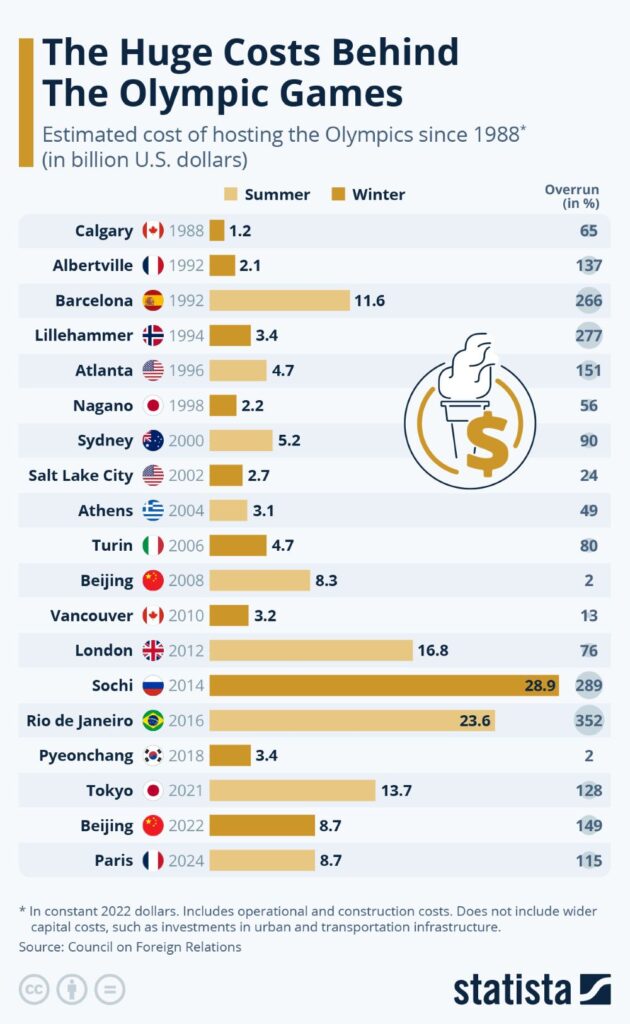
Yet costs still ballooned from €1.5 billion to €5.72 billion. Construction delays plagued venues, and corruption investigations shadowed preparations, with 74 individuals under investigation by July 2025.
But the Games proceeded. Infrastructure was completed, and Italy avoided Victoria’s fate. To be fair to Italy, massive costs were nothing new when it came to the Olympics.
Victoria’s $589 Million Disaster (What Went Wrong)
The Victorian Auditor-General’s damning March 2024 report exposed spectacular incompetence. The state wasted $589 million on an event that never happened, including $380 million in severance fees.
Victoria signed the host contract in April 2022, estimating costs at $2.6 billion. Just 15 months later, Premier Daniel Andrews cancelled the Games, citing blowouts to $6-7 billion. The auditor-general found both figures were wrong: the original budget was “unrealistically low,” whilst the cancellation estimate was “overstated and not transparent.”
Three critical failures doomed the bid:
- Impossible timeline: Commonwealth Games hosts typically have seven or eight years to prepare. Victoria committed to just four years, including building sports venues and four separate athletes’ villages in Ballarat, Bendigo, Geelong and Morwell.
- Unvalidated assumptions: The business case assumed private developers would finance the villages without conducting market soundings. Specific sites weren’t identified or secured, and no alternative options were explored.
- Reckless scope creep: After winning the bid, the government added more sports, an additional regional hub, and changed venue plans—often against the advice of the Commonwealth Games Federation. Consulting fees for the athletes’ village alone reached $21.6 million, nearly 20 times the allocated budget.
According to the audit, government agencies relied on “desktop research” rather than rigorous analysis. KPMG delivered a 22-page economic impact report in four weeks for $55,000 without scrutinising underlying assumptions. An academic reviewer testified that “if a student submitted this as an assignment, they would fail.”
For Geelong, the collapse was devastating. The city had been promised 7,500 jobs and 1,200 procurement opportunities. Local businesses had invested considerable time in tendering. All that work evaporated overnight.
What Brisbane Must Do Differently
Brisbane has seven years until the opening ceremony, and a clear playbook for success if Queensland learns Victoria’s lessons.
1. Embrace Public-Private Partnerships Properly

The Games Independent Infrastructure and Coordination Authority (GIICA) confirmed in March 2025 that PPP arrangements could reduce upfront capital requirements for major assets. Perth’s Optus Stadium provides the blueprint: a design-build-finance-operate-maintain model that transfers construction and operational risks to private contractors.
GIICA estimates that up to half the capital cost of major venues like the $3.8 billion Brisbane Stadium and National Aquatics Centre could attract private participation. The recently appointed Unite32 consortium, led by Laing O’Rourke and AECOM, brings experience from London 2012, Rio 2016, Paris 2024 and LA 2028.
However, PPPs require proper structure. Victoria assumed private sector involvement without groundwork. Brisbane must invest in rigorous procurement despite longer timelines and higher transaction costs.
2. Leverage Existing Infrastructure
Brisbane’s original bid promised 68% of the required venues already existed or could be upgraded. That must remain the foundation. The main athletes’ village will be at the Brisbane Showgrounds, an existing events venue, rather than building four new villages as Victoria planned. The Lendlease partnership exemplifies smart asset reuse.
GIICA’s 2025-26 budget allocates just $145.5 million for venue delivery, amounting to 3% of the $4.7 billion provision. That’s appropriate. Better rigorous upfront planning than Victoria’s incomplete analysis.
3. Enforce Strict Scope Discipline
Victoria’s cost blowouts came largely from post-bid additions. Brisbane has established clearer governance with GIICA overseeing 17 venues and the Brisbane Organising Committee handling Games delivery. But Queensland must resist the temptation to expand for political reasons. Every variation must pass rigorous cost-benefit analysis. Having reliable construction joint venture partners would also help keep costs low.
4. Demand Independent Cost Analysis
Perhaps Victoria’s worst failure was accepting inadequate financial analysisby KPMG. Brisbane needs a thorough independent cost assessment accounting for Queensland-specific factors: labour markets, construction capacity, and materials costs. The 100-day review completed in March 2025 demonstrates a step in the right direction.
5. Plan for Cost Escalation Transparently
Both Victoria and Milan-Cortina experienced massive cost increases. Victoria’s tripled from $2.6 billion to at least $6 billion. Milan-Cortina’s rose from €1.5 billion to €5.72 billion.
Brisbane’s $7.1 billion funding envelope must include substantial, transparently disclosed contingency allowances. Victoria’s political crisis deepened when the government hid $1 billion in contingencies already budgeted. That accounting sleight-of-hand destroys public trust.
Australia’s Credibility on Trial
Victoria’s Commonwealth Games debacle damaged Australia’s reputation as a reliable host.
Olympic champion Natalie Cook called it “un-Australian…a huge blow to our athletes and the green and gold runway that we had set up going into Brisbane 2032.”
The 2032 Olympics is Australia’s chance to prove we can still deliver world-class sporting events. The world will be watching.