

The Geelong Independent looks back on our best Friday features for 2024.
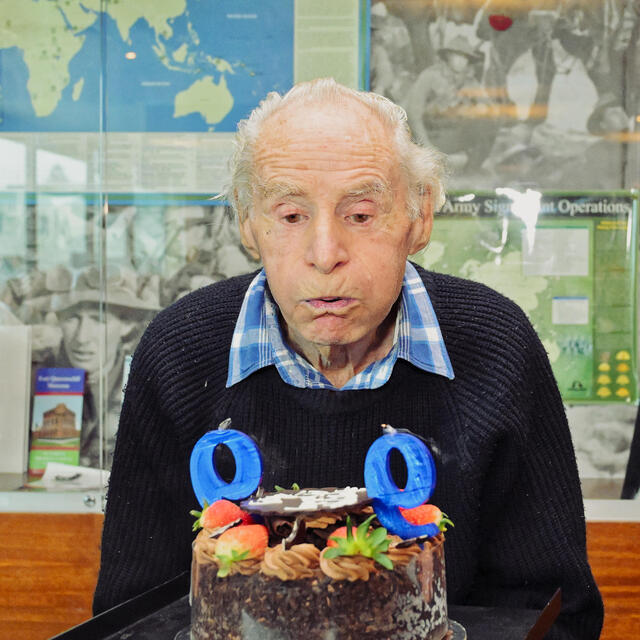
With Anzac Day approaching, Justin Flynn talks to 99-year-old WWII veteran Roy Porter from Ocean Grove about his time in the RAAF and his reflections on war.
Roy Porter was just 18-years-old when he joined the Royal Australian Air Force in the midst of World War II.
The now 99-year-old was desperately hoping it wouldn’t end until he could play his part in defending the country.
“You sort of get excited and hope that the war doesn’t finish before you get into it,” he says.
“Really, it’s sort of a funny feeling. You don’t want people to get hurt, but you want to do your bit for the country. I was at the time frightened…frightened that the war was going to finish before I got into it.
“My mother and father both agreed that it was the right thing to do, but they didn’t want to see their little boy killed.
“My father was at Gallipoli, so I think that’s another reason that I joined up. He was somewhat of a hero. He got himself a citation because he went out and saved wounded soldiers.”
Speaking with a razor sharp memory, and wit, Roy recalls boarding a train at Spencer Street Station for eight months of gruelling training in Sydney and Maryborough, Queensland, and gunnery training at West Sale.
Roy slept in the stands at the Melbourne Cricket Ground when it was requisitioned for military purposes.
“We slept in the stands on cyclone fencing with a bit of water pipe around it and balanced between the two seats,” he says.
After gunnery school, Roy and 19 other members of his squadron were “put on an aircraft and taken away”.
“We still didn’t know where we were going, but I finished up in Batchelor in the NT about 80km south of Darwin,” Roy says.
“We arrived there and realised that we were with the Dutch (East Indies) squadron and the reason that they formed this squadron was that they were short of people, especially air gunners. They had a lot of pilots and they had a lot of navigators because most of them were ex-air crew from KLM.”
The day after he arrived, Roy was thrust into his first operational mission as an air gunner in the 18th Squadron on the B-25 Mitchell aircraft.
The Japanese were making their way from Potshot near Exmouth down the coast.
“We went out looking for three battleships from the Japanese Navy and we went out every day looking for them,” Roy says.
“We couldn’t find them because we found out later that there was an enormous cyclone storm in the Indian Ocean that was so bad that these battleships had to turn back. They went back to Tokyo. So we packed up and went back to Batchelor.”
The squadron was renowned for low-level skip bombing and strafing.
“We did that day after day for nearly eleven months,” Roy says.
“I did over fifty missions. Didn’t get injured, although I crashed three times. One in Brisbane, once in Canberra.
“And a third time I crashed when we were returning from a mission and we didn’t know, but our plane had been shot up and the landing gear was no good. We had a burst tyre which damaged all the landing gear.
“As we touched down we didn’t realise it at the time. We spun around, no one got hurt, but the plane was written off.”
Roy shows a photograph of the 20 Australian air gunners. One row of men are standing and another row kneeling at the front. Roy is at the front. All the men in the back row and their crews were killed. All the men at the front survived.
“They were all good friends,” Roy says.
“The whole plane got shot down so we’d lose the whole crew. You can’t help but think ‘if I was standing at the back would I?’.”
Roy says the only time he was genuinely scared was the night he turned 19.
“I was 18 when I was flying, but on the 7th of April 1944, I turned 19 over the target,” he says.
“That’s the only time I was scared. Just being a bit superstitious, but I’m not a superstitious person. I just thought if anything’s gonna happen, it’s gonna be tonight.”
Roy’s position at the very back of the aircraft meant that “I couldn’t see where we were going, but I could see where we’d been”.
After 11 months of flying operations Roy was sent back to West Sale as an instructor.
The war ended on September 2 1945 after the bombing of Hiroshima and Nagasaki.
“I was pleased it was all over,” he says.
“On the other hand, we were out of work. We couldn’t imagine a bomb being so bad. We used to drop bombs, but the biggest ones we dropped were 1000 pounds or little cluster bombs or incendiaries to start fires in the jungle mainly.
“But most of our flying was against shipping. The squadron was known for its ability to sink ships. And there was a need for that because the Japanese were wanting to invade Australia.”
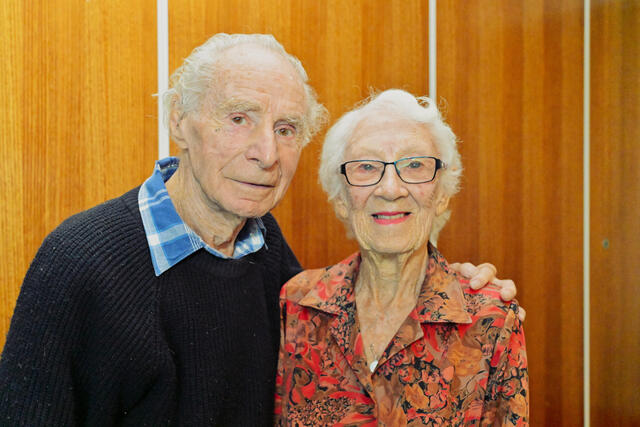
Roy met Norma, eight years his junior, and they were married 70 years ago. They live in Ocean Grove in a house overlooking Blue Waters Lake.
“We got a card from King Charles,” Norma says.
“We met at Coburg Scouts, it was a big thing in Coburg. Some girlfriends were a bit older than me, and I went along. It was Sunday morning and it was always fun meeting with the boys and girls.”
Roy will spend Anzac Day by attending the march and mid-morning service in Ocean Grove. The dawn service is a bit beyond his scope these days.
“After the ceremony we’ll go down to the bowling club and have lunch and a chat,” he says.
Roy will also remember his friends who lost their lives.
One of the air gunners in his crew was captured by the Japanese and “interrogated and beheaded”.
“He slept next to me in the tent and every (Anzac) day I think of him. That’s dirty warfare. I don’t mind fighting, I don’t mind getting shot, but they didn’t want to take any prisoners,” Roy says.
“The funny thing from my point of view is I’m not crook on the ordinary Japanese soldier because he’s only doing what he was told to do and if he didn’t do it, he got shot or killed. It’s instilled into them. But that’s the sort of thing that upsets me.”