

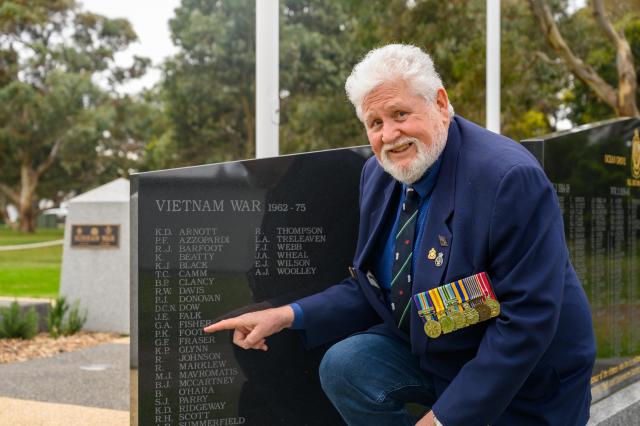
Thursday August 18 was Vietnam Veterans’ Day. Matt Hewson spoke to Peter Foote about his 20 years in the navy and his role in the war.
For Peter Foote, retired Chief Petty Officer in the Royal Australian Navy (RAN), it wasn’t so much that he chose to be a sailor; sailing chose him.
Peter, now 73 and living in Ocean Grove, recalls spending time as a child with his seafaring grandfather in Tasmania.
“My grandfather was connected with the Australian Navy in the first World War, and he’d also been a sailor, merchant mariner, on windjams, including Polly Woodside,” he recalls.
“He’d lived his life on the sea, and when we visited him in Tasmania he was always showing us the boats he’d make, knots to tie. He was a good guiding hand.
“And later I went into the naval cadets, or sea cadets as they were called in those days, in Albert Park lake on the TS Melbourne. I had a little sailor’s uniform, learned all the steps.
And the next progression from there was to get a position in the Junior Recruit Scheme, which was naval entry for young people from 15-and-a-half to 16-and-a-half.”
Just before his 16th birthday in 1965, Peter stepped onto the HMAS Leeuwin in Fremantle to begin his junior training for the RAN, a 12-month intensive course to prepare for his first ship posting.
“It was no rookie school three-month job, it was 12 months of being treated as a full adult,” he said.
“We were well-drilled, fit as anyone could be in preparation for our first ship, and mine turned out to be the HMAS Sydney.”
First commissioned in 1948, HMAS Sydney was Australia’s first aircraft carrier, but by the time Peter joined her in 1966 she had been refitted as a fast troop transport and was already nicknamed the “Vung Tau Ferry”.
“I had chosen engineering as the path I wanted to follow, so I was taught the rudimentaries of all the propulsion machinery down in the engine room and boiler rooms of HMAS Sydney,” Peter said.
“Our job was to take the Army, all its boys and vehicles and anything else they wanted carried, up to Vietnam from Australia.
“It was just before my 17th birthday when I joined the Sydney along with my colleagues from recruit school in WA. We were the youngest people in Vietnam, I think. We weren’t even old enough to vote, but we’d been trained for what we needed to do, and you do it.”
Peter remembers well the tension on board as the crew undertook the 24-hour operation to unload the ship.
“Of a nighttime it was darken ship, it was constantly guarded because we were, of course, something that was of interest to the other side,” he said.
“We had our own ship’s boats and divers checking the hull, as well as armed sentries posted in all areas while we tried to get the gear off.
“At night those of us youngsters who were up on the sponsons were eyeing the fireworks going off in different directions on the jungle side of the hills, which was interesting.”
Over the next two decades Peter served on a number of different ships, including the destroyer escort HMAS Derwent – “she was the greyhound, the guardian, the sheep dog for lovely, juicy targets like the Sydney” – on which he partook in assisting with the Hobart bushfires in 1967 and HMAS Supply, the oil tanker supply vessel for the RAN.
But in between postings Peter continued to study as an engineer, and in 1977 was posted to Williamstown dockyard to become the naval assistant to the general manager’s office.
“The general manager at the time was a naval commodore, and he was surrounded by civilians and public servants,” Peter said.
“My job was basically making sure that the Australian navy ships that were going in and coming out were looked after.
“We accommodated crews whose ships were getting pulled down and put back together, all the logistics of that, and also represented the dockyard when we had open days and other public events.”
As Peter’s time of service approached 20 years, he decided to finish out his time in the navy in the recruitment office in Sydney, but found himself called up to travel to Singapore.
“Due to unforeseen circumstances someone was needed in Singapore to work for the RAN Liaison Office as Chief Petty Officer, and because I was out of branch at the time I was available,” Peter said.
“I ended up spending a good three-and-a-half years there, from 1983 to ‘86. My officer in charge was the Defence attache for Singapore. There were only two of us in the office, and it was an extremely busy but enjoyable time.”
In 1987 Peter retired from full-time service and joined Skilled Engineering, for which he also worked stints in Singapore and Jakarta, before seeing out his professional career in Melbourne.
Peter said he was glad to have served his country for 20 years, and his time in the navy had delivered on its promise of an interesting and event-filled life, but he had missed out on many parts of family life along the way.
“By the time I finished full-time service I was ready to make my way on the civilian side of things,” Peter said.
“I had family, and I’d been away from them more than I should have been. That’s just the nature of being in the navy, but you do miss the home life, the family life.
“I continued with reserve time for the navy after I’d left full-time, but I was ready for no more moving, no more suitcases.”
Peter and his wife settled in Ocean Grove in 2014, and the couple enjoy being away from the hustle and bustle of the city.
“After Eltham, which had changed from being a village to a suburb, we were looking for somewhere that’s a bit quieter, out of the traffic,” he said.
“The kids have grown up and left the nest, and when the work’s done here in Ocean Grove it’s very quiet and enjoyable.
“I still catch up with my old navy chums who are around, I’ve joined the Ocean Grove RSL, the Naval Association, and changed over to the Geelong Vietnam Veterans.
“When we’ve got memorials, parades, I try to lend a hand, or sell badges for ANZAC and Remembrance Days.”