

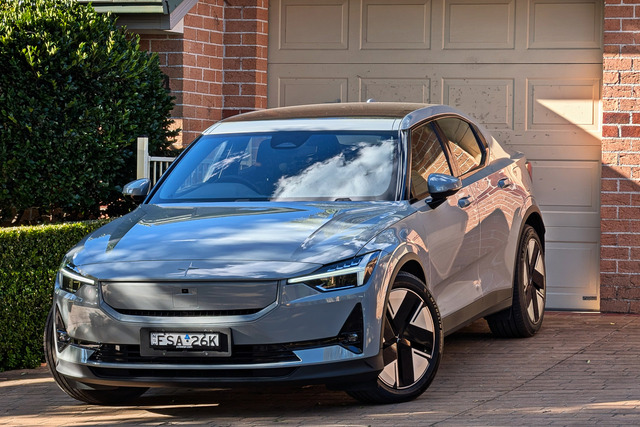
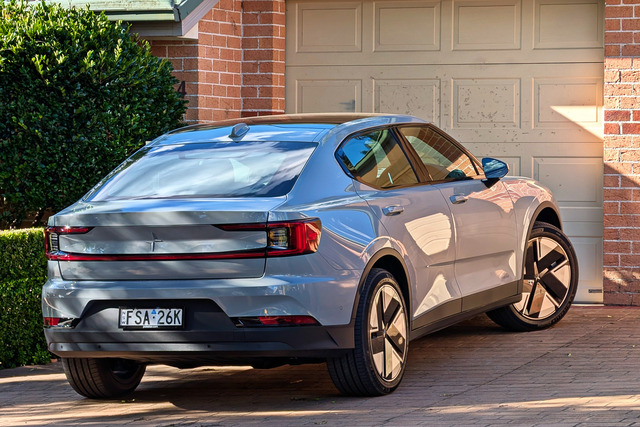
Gosh it seems like a long time since the Australian launch of the Polestar 2 EV.
It was fresh, it was entirely new and it was late November, 2021 – although the car had actually been in production since early 2020.
In fact, the production version was officially unveiled in February, 2019 and made its first public appearance at the 2019 Geneva Motor Show that month.
Yes, it’s been updated since then, but that’s still an awfully long time in the electric vehicle universe which is evolving and expanding at an exponentially rapid rate.
Polestar by the way is an offshoot of Volvo, now owned by the Chinese conglomerate Geely and the cars, or ours at least, are manufactured in China. It also has a factory in Ridgeville, South Carolina, presumably to keep Mr Trump happy, but it must be more costly to make vehicles there.
So, does the Polestar 2 still cut it?
STYLING
A facelifted Polestar 2 was revealed in January, 2023 when rear-wheel drive was adopted as the default.
The entry grade was previously front-drive.
The single motor model was also upgraded to produce 223kW of power and 489Nm of torque, resulting in a faster 0-100km/h time of 6.2 seconds.
Dual-motor models received a boost to 314kW and 740Nm, with 0-100km/h reduced to just 4.5 seconds.
At this time the long-range battery was also upgraded to a capacity of 82kWh.
Since then, however, power outputs have been adjusted to produce a clear, linear progression through the range, starting at 200kW and topping out at 350kW.
The upgrade saw the original mesh grille replaced by a blanked-out version, with an array of sensors and a camera in the centre.
The single motor, standard range is $55,509 driveaway, the long-range single motor version is $74,619 and the long range, dual motor, all-wheel drive is $81,444.
Metallic paint is standard and all models start with the same basic range of equipment.
You can crank the vibe up a notch or two with the addition of various option packs.
Our test vehicle this time around was the Polestar 2 long range single motor version, with a recommended retail price of $66,400 before on-roads and claimed range of 659km – that’s better than some conventional cars.
Standard kit includes embossed, textured textile trim and two-zone filtered air with vents for the rear seats.
Driver and front passenger seats are heated and partly power adjustable, with four-way power lumbar adjustment for the driver. The angle of the seatback must be adjusted manually.
The car rides on 19-inch alloys with wheel covers and has touch-operated locking with puddle lights, LED headlights with active beam, adaptive rear LED lights, retractable frameless mirrors, auto lights and wipers, auto-dimming rear-view mirror, front and rear park sensors and a foot-operated tailgate.
Additional features can be added with the addition of accessory packs: Climate Pack ($1500), Pro ($1900), Plus ($4700) or Performance ($8990).
Pilot Pack which was $3400 is now standard, which means Blind Spot is now standard, begging the question: why is it still listed at all?
Among other things the Climate Pack adds an energy saving heat pump.
Pro adds 20-inch graphite wheels, gold valve caps and black seat belts with a Swedish gold stripe.
Plus brings a raft of features for the price including a full-length glass roof, Harman Kardon sound and a power-operated tailgate.
The Performance Pack is available only with Long Range Dual Motor that has been fitted with the Plus Pack, and not relevant to our review.
Buying a Polestar is a bit different. The whole process takes place online from ordering to payment.
What about a test drive, I hear you ask? You can book that here, either at a designated ‘space’ in each capital city or location requested by you.
Polestar offers a five-year five warranty, along with five years complimentary servicing and roadside assistance.
The battery is covered by an eight-year/160,000km warranty.
Generally, Polestar 2 doesn’t need to be serviced for up to two years or 30,000km.
INFOTAINMENT
Polestar 2 is the first car to come with a built-in Google operating system.
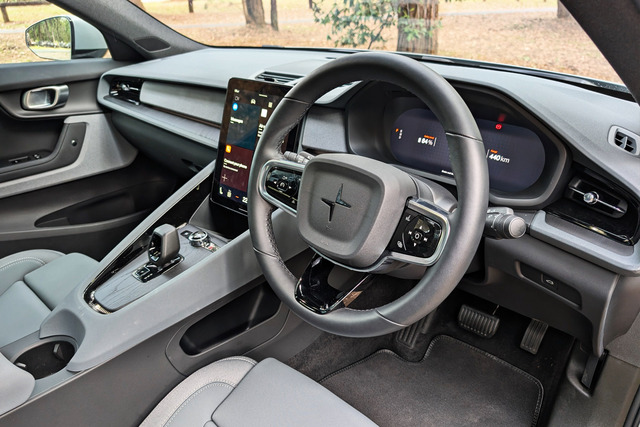
Infotainment is controlled from an 11.2-inch portrait-style touchscreen, now looking somewhat small in comparison to competitors.
High Performance Audio delivers 250 watts through eight speakers, including a bass-boosting air woofer mounted under the bonnet.
The OS includes Google Assistant, Google Maps, with charging options and Google Play Store, which offers optimised in-car apps for seamless integration (with Gemini coming).
There’s also Bluetooth, wi-fi hotspot, FM and DAB+ digital radio, but no AM band – so no emergency broadcasts in tunnels.
Android Auto is supported as is Apple CarPlay, but neither is wireless.
The system is connected to the net via 4G and receives over-the-air updates like a phone.
It will even make an automatic emergency call in the event of an accident (or if the car has been stolen).
Connected Services are complimentary for 12 months but after that you will have to pay to continue using them.
There are two USB Type-C ports in front and two more in the rear of the car, with a 12-volt socket for the luggage area.
You can use the ports to charge your compatible devices, but they do not offer a data connection.
SAFETY
Polestar 2 gets a full five-star crash rating from ANCAP, with a rear-view camera and eight airbags including a centre airbag.
There’s also autonomous emergency braking (Car-to-Car, Vulnerable Road User and Junction Assist) as well as a lane support system with lane keep assist (LKA), lane departure warning (LDW) and emergency lane keeping (ELK), and an advanced speed assistance system (SAS).
Surprisingly, there’s no head-up display for the windscreen.
ENGINES/TRANSMISSIONS
With a 82 kWh Lithium-ion battery, 79 kWh of which is useable, the electric powertrain in this particular model produces 220kW of power and 490Nm of torque, with drive to the rear wheels through a single reduction gear transmission.
DRIVING
Polestar 2 is described as a fastback, but liftback is closer to the mark.
It’s just over 4.6 metres in length, just under 2.0 metres wide with mirrors and has a 2735mm wheelbase.
The sloping tailgate lifts to reveal a long but shallow luggage area, with another hidden area underneath and 407 litres of luggage space.
A small front boot or ‘froot’ is hidden under the bonnet, with a capacity of 43 litres and is handy for storing cables.
There’s no exterior release for the boot which is somewhat annoying as you fumble for the key fob.
You won’t find a spare tyre either with a puncture repair kit provided in the event of a flat.
The 2 was designed by Thomas Ingenlath alongside the Volvo XC40 with which it shares a platform.
The decision to incorporate a radiator grille was a good one because it gave the car a classy look.
The removal of the grille with the latest update, replacing it with a solid panel was a retrograde step in our opinion.
Inside, the fit out is Swedish and minimalist, with grey wood veneer trim and a cabin that has a light airy ambience.
So far so good, but coming from an SUV, the cockpit feels a bit cramped and lacks storage space, with only a small console box.
Much of the available space is given over to the wireless phone charger, which tended to heat up our phones.
Two cupholders are provided, but they are end to end. One is covered by the sliding lid of the console box, and not very practical – back seat passengers get the standard two.
I’m 183cm and my feet kept getting tangled with the foot pedals getting in and out of the car.
Rear legroom is not as generous as you might expect.
Air outlets are provided but the rear windows only partially wind down.
The dash from 0-100km/h takes 6.2 seconds which is pretty quick.
Energy consumption is claimed at 15.8 kWh/100km and the long-range single motor test vehicle has a claimed range of 659km (WLTP).
That’s commensurate with a conventional ICE vehicle, but of course it takes much longer to fill up.
The test vehicle displayed an initial range of 520km while a full overnight recharge upped this to 530km, still 130km short of its supposed range? We were getting 14.9 kWh/100km after 550km of driving.
It took us a while to find the trip metre.
Charging takes as little as 28 minutes using a public, high-powered DC fast charger or eight hours with a home Wallbox – that is if you have three-phase power.
We’ve yet to find a charger that can deliver this kind of speed, even with a bank of Tesla Superchargers just down the road.
The car is supplied with a ‘granny’ or home charge cable, but this can take up to 41 hours for a full charge from a 10A household power point.
Most manufacturers are no longer supplying additional cables as charging stations provide their own (just like a petrol station).
It’s easy to become fixated on range, but it is not really an issue with an EV such as the long range, single motor model, provided you have ready access to a charger when required.
Like Volvos there’s no key or start button. Just hop in, put your foot on the brake, put it into drive and off you go.
Acceleration is quick, but not lightning quick. It’s fast enough however to make you think you’re behind the wheel of something special.
Helping to keep the battery topped up is regenerative braking, which reclaims power when the car is travelling downhill.
You can choose between two levels of regenerative braking or adopt one-pedal mode where there’s no need to apply the brakes.
Just lifting off the accelerator brings the car to a stop. It takes some practice, but may not be to everyone’s liking.
The car weighs over two tonnes, but has a low centre of gravity which helps it sit flat in corners. The weight also impacts the suspension, taking a little longer to respond to bumps.
The ride is sporty. Think Euro firm, but we didn’t find it jarring on our test circuit through the backlots.
But all-in-all the handling is surefooted and it does not become unsettled by unexpected bumps mid-corner like some cars.
Of note be sure you shut the doors properly as the car failed to lock with a door slightly ajar (and did not supply a warning).
We had a running battle with the Google operating system.
We could connect to Android Auto only with the original cable that came with our Google Pixel and both our phones (Pixels) failed repeatedly to reconnect on re-entry.
Google Maps is the default for navigation, but we prefer the more user-friendly Waze which also supports speed camera warnings.
Navigating with Android Auto saw the car totally lose the plot in one of Sydney’s many tunnels.
It’s okay when it works.
SUMMING UP
Polestar 2 remains a favourite, but it has lost the instant appeal that it once had.
It continues however to offer a tight, sporty drive, or very sporty in the case of the dual motor, all-wheel drive version with the works.
At the same time, it’s difficult to believe that the first car to get the complete Google operating system does not support wireless CarPlay or Android Auto, and that it is very picky about the cable you use – that brings back memories.
RATINGS
Looks: 7
Performance: 8
Safety: 8
Thirst: 7.5
Practicality: 7.5
Comfort: 7
Tech: 8
Value: 8
Overall: 7.6