
Watching the Olympics, it’s all about who gets the gold. No one remembers anyone beyond the top three placings and so it goes with utes and the Australian new car market.
Ranger is the gold medalist, with a clear lead, followed by Hilux with the silver and the D-Max with the bronze.
Also-rans include the Mitsubishi Triton, back for a sixth crack at the record but still sitting a fair way back in fourth position out of medal contention.
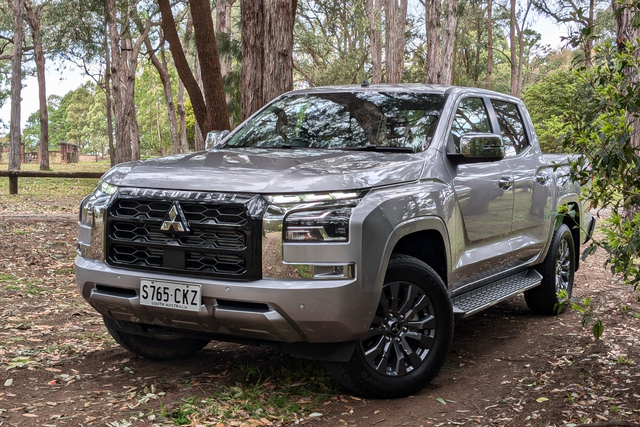
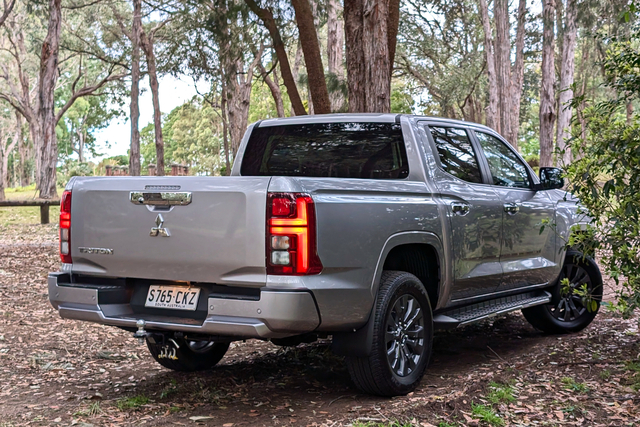
Although its redesigned front now carries the Mitsubishi name, it doesn’t look terribly different from the previous model and even bears a passing resemblance to the Hyundai Palisade.
STYLING
They now want more than $90,000 for the top of the line Ranger Raptor, even though it’s powered by a thirsty petrol V6.
The good news is that you can get into a Triton for much less and it comes with a sensible diesel engine, which pretty much sums up the Mitsubishi ute – it’s always been value for money.
Having said that, we were a bit surprised to find our test vehicle, the second from the top GLS, doesn’t come with leather or power-adjust seats.
But at least satnav is standard – it wasn’t that long ago that even top spec Mitsus missed out on built-in navigation.
Standard equipment includes climate air with roof-mounted vents for the rear seat, auto high beam, adaptive cruise control, traffic sign recognition, auto lights and wipers and front and rear parking sensors.
GLS adds 18-inch alloys, road tyres, dual zone climate air, leather wheel, shifter and parking brake, LED head and daytime running lights, power-fold door mirrors, keyless entry and push-button start, an auto dimming rear view mirror, plus premium sound.
INFOTAINMENT
Infotainment includes a 9.0-inch touchscreen (up from 7.0 inches), built-in navigation, AM/FM and DAB+ digital radio, Bluetooth connectivity with voice and steering wheel controls, plus wireless Apple CarPlay and wired Android Auto along with a six-speaker audio system.
USB-A, USB-C ports and a 12-volt outlet are located in the front, with the same setup for rear-seat passengers and a wireless phone charger in GLS and GSR.
A physical control knob is provided to control audio volume.
SAFETY
New Triton scores a five-star safety rating, with eight airbags, a 360-degree overhead camera and a comprehensive safety suite that offers two class firsts: Front Cross Traffic Alert and Driver Monitoring System.
Blind Spot, Rear AEB, Forward Collision Mitigation with pedestrian detection, cyclist detection and junction assist add to the list. A centre airbag is offered for the first time.
ENGINES/TRANSMISSIONS
The ‘new’ 2.4-litre four cylinder diesel features two turbochargers, one small for faster response at low revs, and a larger one to boost the top end.
It develops 150kW of power at 3500 rpm, with a 470Nm peak torque figure that’s available from just 1500 to 2750 rpm.
Both 4 x 2 and 4 x 4 drivetrains are offered with an updated six-speed auto, while a six-speed manual will become available later with some variants.
DRIVING
New Triton features a longer wheelbase and it is slightly longer and wider, providing more space, comfort and load capacity.
The tub itself measures 1555mm in length (+35mm), 1545mm in width (+25mm) and 526mm in depth (+51mm) and includes a tray liner in this variant.
And for the first time, Triton earns a 3.5-tonne braked tow rating and can carry a one-tonne payload across the range.
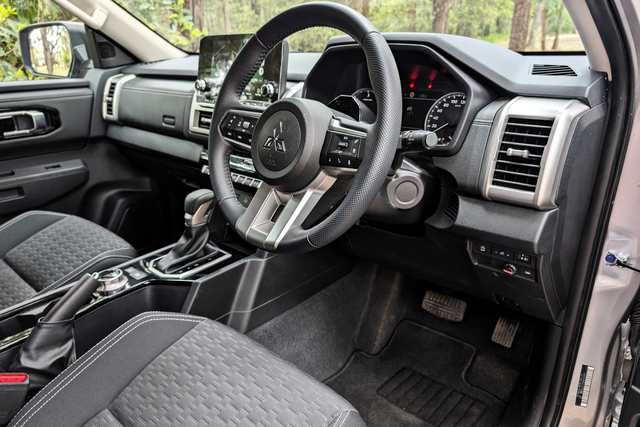
A new three-dimensional door handle allows easy opening in any hand position while a new steering wheel features soft-touch materials with enhanced thumb-rests for added comfort.
The start button has been relocated inboard and the larger, but not that large touchscreen, is now freestanding. The instrument dials have been pushed further apart to make way for a larger information panel which now includes digital speed. But the dials themselves are still old-school analogue with no customisation available to play with. Guess the customer focus group didn’t express any interest in this?
On the road the new Triton certainly feels smoother and more refined, but is otherwise unexceptional.
Power is up from 133 to 150kW and torque from 430 to 470Nm, the latter available much earlier in the rev range.
The new engine and gearbox are designed to produce better response and more low-down power, with flat torque delivery throughout the rev range, along with better fuel economy.
Part-time high and low range 4×4 is offered in two forms, Easy Select and Super Select II for GLS and GSR, with selectable drive modes and a rear diff lock — the latter confined to GLX+, GLS and GSR.
Active yaw control automatically brakes the rear wheels to reduce over and understeer in corners.
Fuel consumption in the case of our GLS has dropped from 8.6 to a claimed 7.7L/100km. We trimmed a little bit off this, returning 7.6L/100km from the 75-litre tank after close to 400km of mixed driving.
Auto engine stop-start is fitted to enhance efficiency, with a 17-litre AdBlue tank to reduce NOx emissions.
However, the engine takes about half a second too slow to restart when the lights go green and it had other motorists beeping us for being a slowcoach. We’re told more than 100 front and rear suspension combinations were tested in Australia over several months.
After extensive benchmarking against competitors and the current model, a unique front shock absorber and spring combination was selected, along with a unique specification for the rear shocks.
Rear leaf springs are retained across the board, but the number and thickness of the leaves has been reduced, with both heavy duty and standard duty versions – the latter for GLS and GSR.
The rear brakes remain drums and it has a mechanical parking brake.
It all sounds promising and while the ride is generally smoother and more controlled, the suspension still produces an annoying staccato over across the low amplitude bumps common to our roads.
Upon reflection, it doesn’t bode well for equally common corrugated dirt roads. Maybe we should go with them next time?
The 4×4 benefits from a low-range ratio of 2.566, further enhancing low-speed response and pulling power.
Ground clearance is 228mm and seven off road drive modes are offered with the GLS and GSR: Normal, Eco, Gravel, Snow, Mud, Sand and Rock.
GLX and GLX+ get 265/65 all terrain rubber, GLX 2WD, GLS and GSR get more road focused 265/60 profile highway terrain tyres.
A full-size spare is provided (alloy for GLX+, GLS and GSR).
A class first driver monitoring system watches for fatigue and issues an alert if it detects distraction. It’s an absolute shocker and Mitsubishi has issued a fix which will be retrofitted to vehicles already on the road. If fatigue is detected by the steering wheel-mounted camera, Forward Collision Mitigation and Lane Departure Warning are calibrated to kick in earlier. It results in so many false alerts that we soon tried to turn it off, only to discover that it reactivated at each start. Even picking your nose triggers the bloody thing.
SUMMING UP
In a sea of 4×4 dual cab clones, only the distinctive grille sets the Mitsubishi Triton apart.
The latest model is definitely a step up, with a contemporary cabin, the requisite touchscreen and wireless charge pad. But so too is the price, with the review GLS now $10,000 more than it cost 12 months ago.
You get what you pay for as they say but the problem is there’s nothing that really screams ‘buy me’ from where we’re sitting.
It’s not enough to just match the competition, you have to catch and pass them.
Sorry.
RATINGS:
Looks: 7.5
Performance: 7
Safety:7.5
Thirst: 7.5
Practicality: 7.5
Comfort: 7
Tech: 7
Value: 7.5
Overall: 7.3