
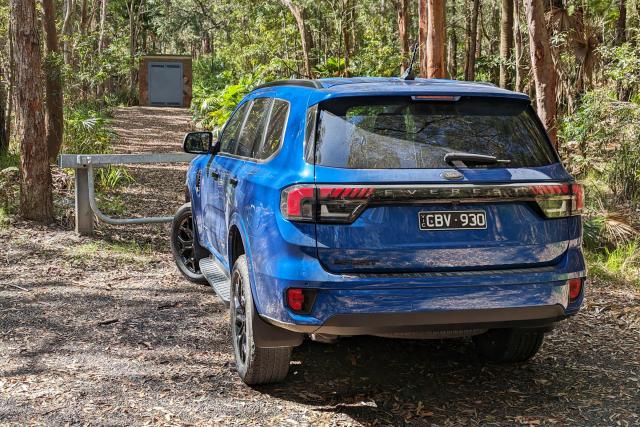
Some of Ford Ranger’s magic must have rubbed off on Everest because it’s now one of the top 10 best-selling cars in Australia, second only to the Toyota Prado in its segment.
The last time we drove Everest we were pleasantly surprised by the wagon and the latest, third generation model is no exception, in keeping with the market response.
It’s ironic because sometimes we critics can bag the crap out of a car, then stand back amazed as it sells its socks off.
Go figure.
STYLING
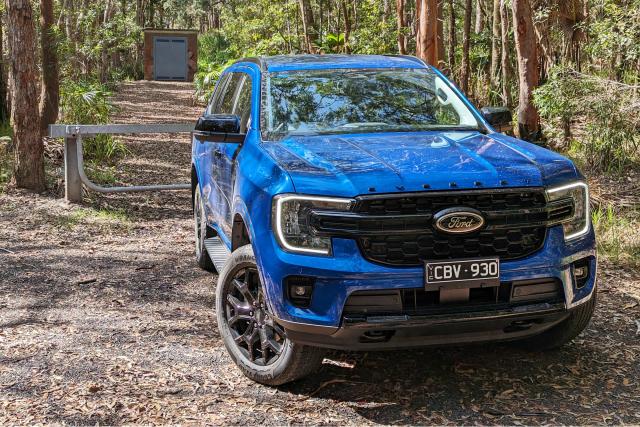
Everest adopts the same ‘tough’ look as the Ranger, bluff and squared off where the previous model was rounded.
It’s more muscular in appearance and targeted at blokes, and is light years from the Ford Territory that pioneered this segment for the brand 20 years ago.
The rear is obviously different, with broad, strong horizontal lines.
The Sport grade has proved popular and is now available with a choice of 3.0-litre V6 or 2.0-litre four-cylinder turbo-diesels, together with rear- or all-wheel drive.
Sport is readily identified by the black treatment that everyone seems to want these days, with black trim, black wheels and black raised lettering for the badges. And it’s the only grade available in the exclusive colour Blue Lightning, as pictured.
Inside there’s two-zone climate air, with part-leather, Sport-embossed front seats that are heated and cooled.
The driver seat is 10-way power adjustable with memory setting while the front passenger seat is eight-way power-adjustable.
All grades apart from Ambiente come with three rows of seats.
Standard kit includes 20-inch alloys, side steps, LED head, tail and daytime running lights, electric parking brake, keyless entry and start, auto lights and wipers, auto high beam, speed sign recognition, adaptive cruise control, auto dimming rear view mirror, front and rear parking sensors.
Prices start from $53,490 for the 2.0-litre rear-drive Ambiente.
Trend is priced from $60,990, Sport from $62,990, Wildtrak from $72,804 and Platinum from $77,000, all before on road costs.
Our test vehicle was the rear drive Sport with the 2.0-litre engine. If you want all wheel drive, it’s packaged with the V6 and comes at a cost of $70,590.
Prestige paint adds $700 (everything but white) and the tow pack is $1700.
Everest is covered by a five-year unlimited kilometre warranty, roadside assistance if you get it serviced by Ford and a pre-paid service plan is available at a cost of $1200 for the first four general services for up to four years or 60,000km.
INFOTAINMENT
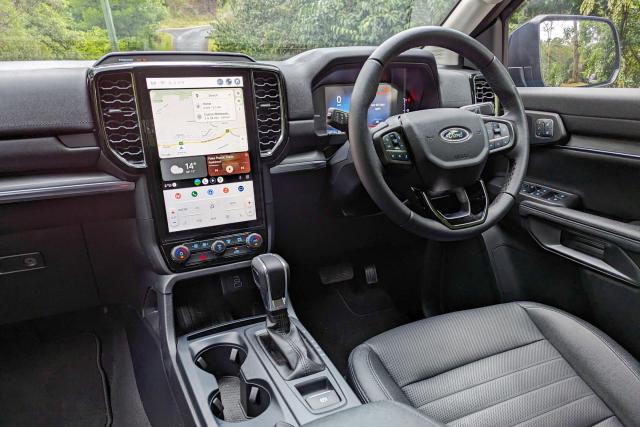
Pride of place in the cabin goes to the SYNC4A infotainment system with voice activation and a huge 12.0-inch Tesla-like vertical touchscreen with 10-speaker audio.
The system features Bluetooth, built-in satnav with one year of connected navigation services, DAB+ digital radio, both wired and wireless Apple CarPlay and Android Auto, and wireless charging.
There are two USB ports in front (USB-A and USB-C), two in the back (USB-A and USB-C) plus a 12-volt outlet in the front console box and another unlabeled outlet in the luggage area.
The FordPass app allows you to view vehicle status. You can also remotely unlock the vehicle, activate zone lighting where fitted, and start the vehicle to activate the climate control.
ENGINES/TRANSMISSIONS
The four produces 154kW of power at 3750 rpm and 500Nm of torque from 1750-2000 rpm, while the larger 3.0-litre V6 delivers 184kW at 3250 rpm and 600Nm from 1750-2250 rpm.
Both are paired with a 10-speed auto, with four drive modes in the rear-drive Sport: Normal, Eco, Tow/Haul and Slippery.
SAFETY
ANCAP says Everest’s five-star safety rating is based mainly on test results for the Ford Ranger utility on which it is based, with supplementary information from Ford (not sure why).
It has nine airbags, including driver and passenger knee airbags along with the latest centre airbag which provides added protection to front seat occupants in side impact crashes is also standard.
There’s also a rear-view camera, Autonomous emergency braking (Car-to-Car, Vulnerable Road User, Junction Assist and AEB Backover) as well as a lane support system with lane keep assist (LKA), lane departure warning (LDW) and emergency lane keeping (ELK), and an advanced speed assistance system (SAS) are standard. There are five top tether child seat anchors and another two Isofix anchors.
DRIVING
Everest is big, at 4914mm long and 1842mm tall, with a wheelbase of 2900mm.
It has 230mm of ground clearance whether it’s the 4×4 version or not and this model tips the scales at 2295kg.
The dimensions are roughly the same as before, with a 50mm increase in track and wheelbase.
The changes have been made to accommodate the V6 and the new hybrid when it finally arrives.
The longer wheelbase means more space inside, but the height of the vehicle also means getting in and out could be problematic for short people, particularly less athletic ones.
There are only 259 litres of space behind the third row of seats, rising to a healthy 898 litres with the third row stowed.
Everest comes with a choice of engines depending on the grade. There’s also rear and all-wheel drive to factor in.
Ambiente and Trend kick off the range with a 2.0-litre twin-turbo diesel, while Wildtrak and Platinum bring a Ford-sourced 3.0L V6 turbo-diesel.
Mid-range Sport can be had with either – RWD with the four, AWD with the six.
This model is fitted with 255/55 series Goodyear Wrangler Territory HT road tyres. A full-size alloy spare is provided.
Whichever model you choose, it can tow a 3500kg load, but there’s a thing called gross combined mass to consider and the V6 is probably the better option for towing.
Like most cars these days starting Everest is accomplished via a button that takes the place of a key. In Everest that button literally takes the place of the key mechanism in the barrel on the steering column.
It’s a bit of an oddity and had us looking for a button each and every time we started the wagon – either in the console or to the left or right of the wheel.
The instrument cluster is part digital in this model with a rather unimaginative 8.0-inch squared off display that sits between traditional analogue gauges. It’s not until you get to the top of the line Platinum that it’s flashier and all digital, with a 12.3-inch screen.
Looking and running your hands over surfaces in the cabin reveals plenty of hard, cheap, generic plastic trim, detracting from the ambience.
The honeycomb air vents are a case in point.
But most eyes will be focused on the Tesla-like touchscreen which provides plenty of real estate for satnav and secondary controls, although we’re not sure why it is necessary to have both physical and electronic controls for the aircon.
The system can be slow to boot and at one point the screen blacked out for 30 seconds during which it remained unresponsive. Wireless Android Auto worked flawlessly.
The four-cylinder twin turbo diesel is basically the same unit that powered the Raptor five years ago with a little tweaking.
In that context and producing 500Nm of torque from a low 1750 rpm, it is anything but disappointing. The V6 is just icing on the cake.
Unlike most diesels, the four feels smooth and quiet, with a real spring to its step.
Changes are smooth and those 10 speeds make sure the engine is always where it needs to be, but it feels a little busy at times.
Adaptive cruise control works all the way down to a dead stop, before going again, and with intelligent speed assist active will automatically change to the current speed limit.
Rear suspension is different to that in the ute, more sophisticated to make things more comfortable for rear seat occupants.
But our passengers still complained about ride quality in the back and the ride quality is generally a little jiggly and not as good as a sedan.
It’s good to see plenty of rear air outlets, located in the roof, which will stop the kids from getting sick.
Auto engine stop-start is fitted and cycles down the aircon with the engine. The result can be stifling on a hot day and freezing when it’s cold, but can probably be turned off. Try as we may, we couldn’t get hot air into the back on a brisk Canberra day.
The cabin is a nice, quiet place to be on the road, thanks to an acoustic windscreen and well sound-proofed engine – but there’s no mention of noise cancelling technology this time around.
There are no gear change paddles. Instead, a thumb-controlled rocker switch at the top of the shift lever performs the same function. It’s okay for occasional changes, but no good for long term use.
The steering has gone from light to hard work, mainly because of the lane-centering assistance. Take your hands off the wheel and the car will steer itself for a good few seconds, including bends, before you’re warned to put your hands back on the wheel.
It wants to do the work and the trick is to let it do most of the work instead of fighting the wheel which can become tiring – or simply turn it off with a switch conveniently located on the wheel.
With an 80-litre fuel tank, combined fuel consumption for this model is a claimed 7.1L/100km. We were getting as little as 7.8L/100km after almost 1200km of mixed driving. That’s pretty good for a vehicle this size.
SUMMING UP
Women may not like the styling and the heavy steering made my wife’s arms ache, but overall, it’s pretty good.
The rear-wheel drive 2.0-litre Sport could be the one to get, because it’s visually appealing and comes with everything you want and nothing you can’t do without. It represents a considerable savings over the off-road version which the majority of people will never use anyway.
RATINGS:
Looks: 8
Performance: 7.5
Safety: 8
Thirst: 8
Practicality: 7.5
Comfort: 7.5
Tech: 7.5
Value: 7.5
Overall: 7.7