

Hyundai’s mid-sized SUV Tucson has been around since 2004.
The current (fourth generation) was released here in February 2021 with the latest (MY2025) upgrade launched here in mid-2024 and adding a hybrid variant for the first time.
Tucson comes with a choice of 17 variants with Tucson, Elite, Premium and N-Line equipment levels and the choice of 2.0-litre naturally aspirated petrol, 1.6-litre turbo-petrol and 1.6-litre turbo-petrol hybrid powertrains as well as two or all-wheel drive.
The Tucson has plenty of pull, boasting a 1900kg towing capacity, plus a first-in-class panoramic curved 12.3-inch infotainment/driver display backed by wireless Apple CarPlay, Bluelink, connected car services and over-the-air remote software updates.
The maker’s SmartSense safety system now has Highway Driving Assist, while a new head-up display presents important driving and navigation information. On test was the Tucson Elite Hybrid N Line front-wheel drive, selling for $48,600, plus on-road costs.
The new hybrids are covered by Hyundai’s five-year unlimited kilometre vehicle warranty and eight-year 160,000 kilometre high-voltage battery warranty, as well as Hyundai’s Lifetime Service Plan, Premium Roadside Support and satellite navigation updates.
STYLING
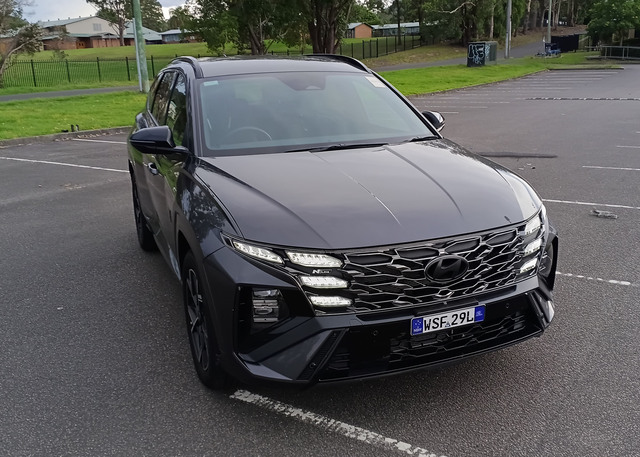
We love the adventurous styling route that Hyundai has taken with the Tucson.
The large hatched grille gives a bolder look than before and is fringed by five LED daytime running lights in a crescent formation. The headlights are full LED and automatically adjust to the sides for improved cornering visibility.
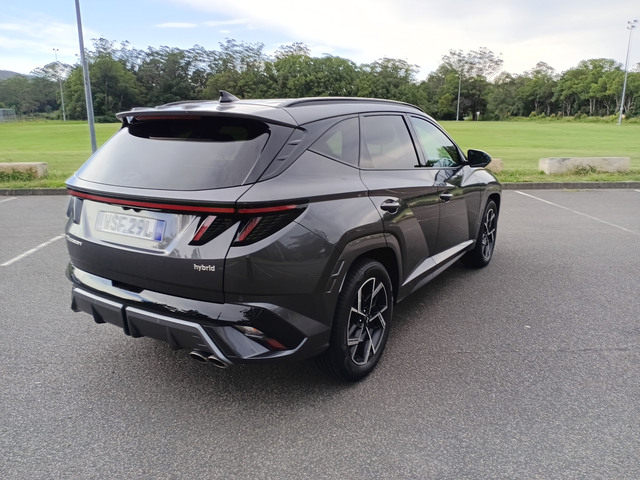
Our test vehicle came with the optional N Line pack consisting of exclusive 19-inch wheels, grille, front bumper and skid plate, plus N Line badging. The rear sports a new rear bumper, skid plate and twin exhaust outlets.
INTERIOR
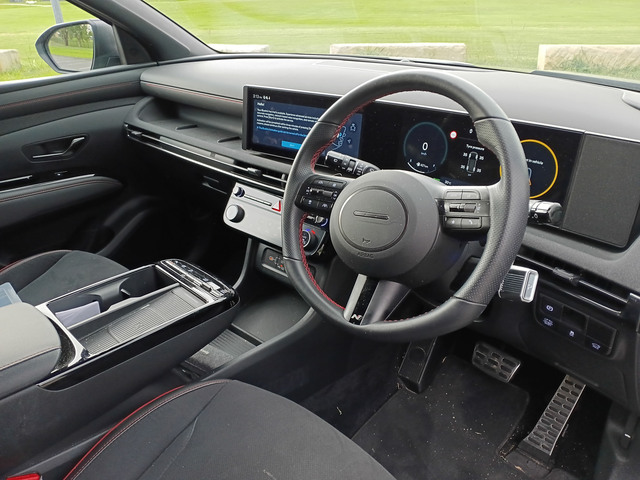
The MY25 cabin has been given the once-over to especially appeal to the lifestyle active family. The steering column has a mounted drive-by-wire shift selector and floating centre console.
The Elite and Premium variants feature classy leather appointed seats for up to five while the N Line pack goes further with black leather and suede, red stitching, plus exclusive N Line seat and steering wheel emblems.
General storage includes large door pockets and a deep lidded console box. Cargo space runs from 582 litres to 1903 litres depending on the seats in use. The spare wheel is a space saver variety. A height and speed adjustable tailgate is operable via a button on the key fob or by simply standing at the back of the vehicle with the key.
INFOTAINMENT
A 12.3-inch touchscreen, introducing Hyundai’s next generation user interface, is standard across the 2025 Tucson range and comes up with four times the computing power and 15 times the graphical processing power of the previous system.
A host of functions is led by wireless Apple CarPlay and Android Auto, AM/FM/DAB radio, Hyundai Bluelink, Bluetooth multiconnection, USB-C input, quick control (swipe down) menu, and over-the-air updates.
Elite and Premium variants add Bluelink sat nav with turn-by-turn directions, live traffic updates, voice control, SMS playback and split screen function. Bluelink connection is free for the first five years and includes automatic collision notification, emergency call access, remote control climate and vehicle functions, among other things.
A similar-size configurable digital instrument cluster takes on a classic look with needle-style gauges. Hybrid versions can be customised to display a power gauge or tachometer. Depending on the drive mode.
ENGINES/TRANSMISSIONS
Tucson Elite N-Line test vehicle was powered by a 1.6-litre 4-cylinder turbo-petrol/electric hybrid system, mated with a six-speed automatic transmission, driving the front wheels.
The petrol motor put out 132kW of power and 264 Nm of torque.
The electric motor contributed a further 47.7kW of power, making a combined maximum of 172kW. The latter made use of a lithium-ion polymer battery of 1.49kWh and 270 volts.
SAFETY
The Tucson Hybrid has a five-star ANCAP safety rating on 2021 testing. The vehicle body features high-strength, lightweight construction to maximise torsional rigidity.
Active safety comes with Hyundai’s SmartSense suite, which includes forward collision avoidance, lane keeping assist, blind spot collision avoidance, safe exit warning, driver attention warning, high beam assist and smart cruise control.
A surround 360-degree view of the car and rear-view monitor, plus distance warning, are a great help when parking.
DRIVING
Quick, yet quiet is the best way to describe the Tucson hybrid’s behaviour. The turbo dials up the power, while the electric motor plays its part in smooth going, as does the six-speed auto transmission.
Road noise on coarse road surfaces is the only intrusion into the cabin. The suspension coped with generally few complaints, while the brakes had their sharp side if rushed into action.
Gear selector is a twist-shift to the right of the steering column which takes some getting used to but clears the way for an uncluttered centre-console controls such as drive modes.
These include Eco and Sport, of which the latter added sharpness all round to the drive.
Smart mode switched the car between Eco and Sport to ostensibly maximise economy and performance, if that’s possible.
Hyundai claims combined urban/highway fuel consumption of 5.3 litres per 100km. The test vehicle came up with 4.6 litres per 100km on the motorway and averaged up to 9 litres per 100km during a week’s running around town.
SUMMARY
It’s anybody’s guess whether buyers will take the hybrid route to Tucson electric vehicles. It’s a veritable traffic jam in this segment.
RATINGS
Looks: 8/10
Performance: 7/10
Safety: 8/10
Thirst: 8/10
Practicality: 7/10
Comfort: 7/10
Tech: 7/10
Value: 8/10