
Back in the day, most utes lived up their ‘utility’ tag, being up for almost anything.
Since then, the tradies’ favoured transport has morphed into a cohort of shiny, lumbering limos, with dual cabs doubling as passenger compartments with all the creature comforts.
With Ford and Toyota (not to mention RAM and other American muscle marques) leading the way, Ranger and HiLux have become genuine family favourites. Not to be outdone, Mitsubishi has its two ‘pennorth’ with the Triton GSR flagship.
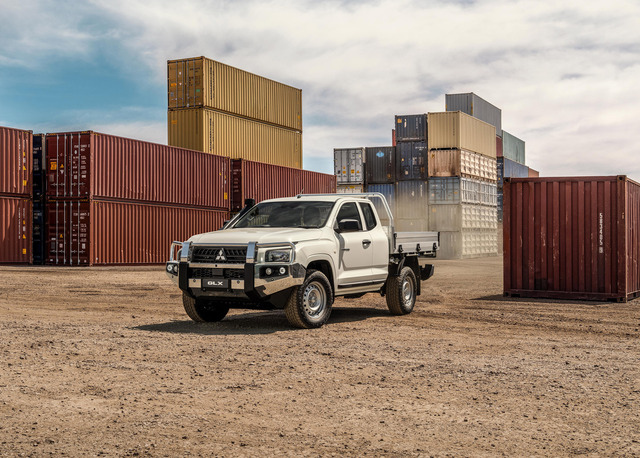
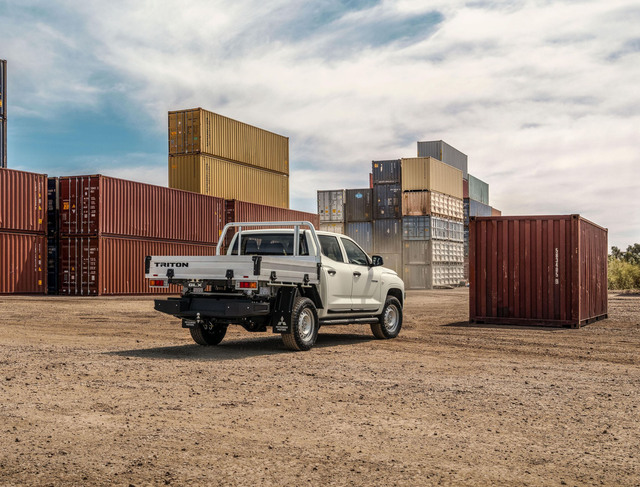
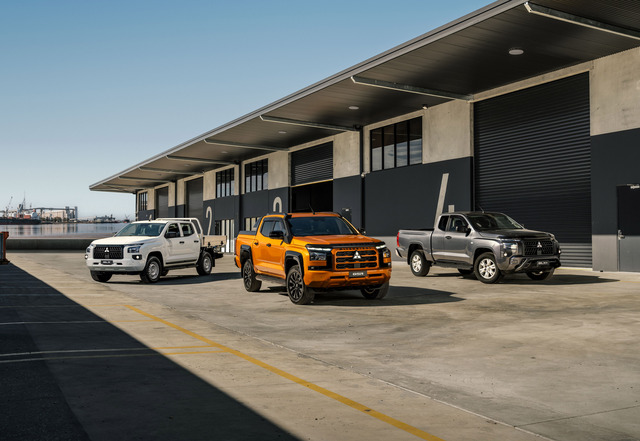
Now this, the Triton Double Cab Pick-Up, has been augmented by work-minded Cab Chassis models for MY25.
“Cab Chassis and Club Cab variants provide customers with another chance to own a vehicle that suits their lifestyle, from tackling their trade to seeking out weekend adventures,” Mitsubishi’s Australian general manager product strategy Bruce Hampel said.
“Our aim is literally to drive Australians to be more adventurous, and these new models give Triton the product depth to deliver on this promise.”
Cab Chassis pricing starts at $34,490 for the GLX Single Cab – Cab Chassis (2WD, manual) and tops out at $61,540 for the GSR Double Cab – Cab Chassis (4WD, automatic), the test vehicle.
The Triton range is covered by Mitsubishi’s 10/10 Diamond Advantage warranty for 10 years/200,000km and 10 years capped price servicing. Up to four years complimentary roadside assist is also on offer.
STYLING
Carrying an appealing range of tray options, available through the company’s Mitsubishi Genuine Accessories, leading the way with an integrated rear-view camera offering added confidence when reversing.
Trays have a galvanised finish, with the premium steel trays offer a choice of galvanised or body colour. Door mirrors fold away. LED headlamps and daytime running lights make a modern statement.
Lower classes carry a black radiator grille, Triton front door badge and engine front undercover in metal (4×4 models), or composite (4×2), while upper echelon GSR sports body coloured grille and wheel arch moulding and roof rails. Eighteen-inch black alloy wheels complete the picture.
INTERIOR
Step into the cab of the entry-level GLX with muddy boots? No sweat, there’s a vinyl floor covering. Seat trim is hard wearing cloth, the driver supported by electric lumbar facility. Storage comes with two cup holders, two bottle holders and a spot for sunglasses.
The Double Cab comes with a second-row bench seat, with centre armrest including cup holder. The seat back pocket is good for phone and tablet storage. There’s generous leg room out back.
The GSR runs on exclusive leather seats with orange accent stitching, unique floor mats, soft padding surfaces and dark titanium accents. There are two dash-mounted cup holders, and power driver seat, with slide, recline, height and lumbar support functions.
INFOTAINMENT
Comfort and convenience are covered by dual zone air-conditioning with rear air circulator. Electronics include a 7-inch LCD MID meter cluster, integrated sat nav and a single front USB-A port and USB-C port plus wireless phone charger.
There’s a 9-inch infotainment display and four-speaker DAB audio. Connectivity is via wireless Apple CarPlay and Android Auto using voice and steering wheel controls.
ENGINES/TRANSMISSIONS
The Mitsubishi Triton range features Mitsubishi’s latest 2.4-litre Bi-Turbo diesel engine, producing 150kW peak power, plus 470Nm peak torque, between 1500 and 2750rpm. A six-speed manual gearbox is available on a range of GLX and GLX+ models, with an updated six-speed automatic gearbox also available range-wide.
SAFETY
The expanded Triton range retains five-star ANCAP safety rating, tested to the latest stringent protocols. The oft misnamed ‘passive’ features include driver and front passenger front and side airbags; centre airbag; driver knee airbag and curtain airbags.
So-called ‘active’ safety assist technology – collision warning and avoidance – is made up of forward collision mitigation with pedestrian and cyclist detection, plus junction assist.
There begins the usual laundry list of warnings, alerts and prevention, taking in safety assistance encompassing braking and vehicle stability, the latter catering for trailers and other towed equipment.
DRIVING
The new engine and gearbox combination is designed to produce exceptional response and low-rev pulling power, coupled with linear torque delivery throughout the rev range for improved load carrying and towing capability.
With powertrain leaning towards the workhorse stable, the new Triton does pick up a few bumps and bangs on bitumen past its use-by date.
The bi-turbo system improves efficiency over the previous generation, resulting in real world fuel consumption of the test vehicle averaging more than 9 litres per 100km CBD and suburbs and 6.5 litres cruising the motorway.
The new Triton takes advantage of Mitsubishi’s Super select 4WD-II system which continues to offer 2H, 4H, 4HLc and 4LLc drivetrain settings. Now, as part of the company’s All Wheel Control there are seven drive modes accessed via a button on the centre console.
These cover varied conditions from ‘normal’ to ‘rock’ going, with eco, gravel, snow, mud and sand in between. The result is a system that enables a 40/60 front/rear drive while leaving the centre differential unlocked, producing optimum traction on slippery surfaces without reducing on-road performance.
For even more traction, high range four-wheel drive with locked centre diff (4HLc) gives a 50/50 locked drive split, front and rear. The rear differential can be locked via a console-mounted button giving maximum pulling power.
Rallying gets in on the act with brake active yaw control, which monitors yaw angles based on driver input and road conditions, shifting torque between inner and outer wheels using the braking system.
SUMMARY
Work hard/play hard/don’t sleep much: that was a common lifestyle of me and my student mates back in the day. A bit like the modern Triton, really.
RATINGS
Looks – 8
Performance – 8
Safety – 8
Thirst – 7
Practicality – 7
Comfort – 6
Tech – 7
Value – 8